Winning the Buy Box is not always just about offering the lowest price. In many cases, multiple factors influence which seller is awarded the Buy Box. It is also possible for a product to have no Buy Box available at all.
In this blog, Marketplace Specialist Fabian Booijen shares his practical experience on how the Buy Box works, the factors that influence your chances of winning it, and how to avoid a race to the bottom on price.
How Does the Buy Box work on Amazon and bol?
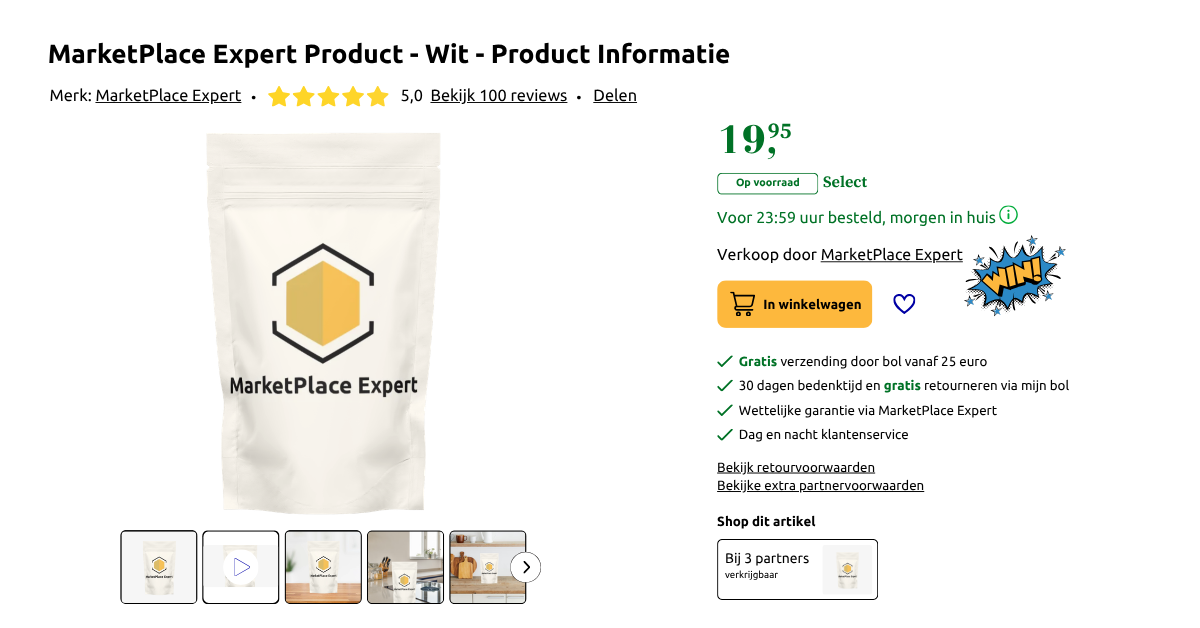
On Amazon, this feature is known as the Buy Box, while on bol it is referred to as the Buy Box (koopblok). This is the section where customers can purchase a product directly. In addition, there are often multiple sellers available through the list of other offers.
What many sellers do not realize is that the Buy Box is not always available.
On bol, for example, a product can disappear from the Buy Box entirely if the price is lower on another platform. Bol compares prices based on the product’s EAN and determines whether an offer is competitive enough. After all, the platform aims to provide customers with the best possible shopping experience. If an offer is not considered competitive, the product may even be displayed as unavailable, despite being in stock.
Amazon handles this differently. In most cases, your offer remains visible even if you lose the Buy Box. Customers can still purchase your product, but it will no longer occupy the prominent Buy Box position.
Bol also uses price ratings such as Very Competitively Priced, Competitively Priced, Market Price, and Above Relevant Market Price. These ratings influence the visibility of the Buy Box.
Which Factors influence Buy Box success?
When the Buy Box is available, the platform determines which seller is awarded it.
The most important factor is price. According to Fabian, it is by far the biggest deciding factor.
“Price is by far the most important factor in winning the Buy Box. Only when prices are very close to each other do other factors start to play a role.”
The platform will then look at delivery time. If delivery times are also similar, additional performance metrics come into play, such as:
Customer reviews
Seller ratings
Seller reliability
How important is delivery time for the Buy Box?
As mentioned above, delivery time is important, but it is usually not the first deciding factor. Fabian explains:
“Delivery time is important for the Buy Box, but only when price is no longer the deciding factor.”
As long as there are clear price differences, price will usually remain the leading factor. Only then do Amazon and bol consider delivery time.
In practice, delivery time is also less flexible than price. It often depends on agreements with carriers and fulfilment processes.
When is repricing necessary?
For products with many sellers, the Buy Box changes hands continuously. This is especially common for well-known brands and popular products, which is why many sellers use an automatic repricer.
A repricer constantly monitors the current price on a listing and automatically adjusts your own price based on predefined minimum and maximum price limits.
“You may have the Buy Box in the morning, only to lose it to a competitor a few hours later,” says Fabian.
For brand owners, the situation is often different. They sell their products to resellers first. As a result, it generally matters less to the brand who ultimately wins the Buy Box, because the products have already been sold and the brand has already generated its revenue.
That is why repricing is not always the best choice for brands. It can disrupt a carefully planned pricing strategy without delivering a direct benefit.
For resellers, however, a repricer can be essential, especially when many sellers are competing on the same product listing and you want to remain competitive.
How can I avoid a race to the bottom on price?
According to Fabian, completely avoiding a price war is virtually impossible.
When multiple sellers use repricers, prices continuously respond to one another. As soon as one seller lowers their price, others often follow automatically.
The best protection is to set realistic minimum and maximum prices. This helps safeguard your profitability and prevents you from unintentionally selling at a loss.
However, it remains a free market. Sellers can source products through different channels and list them again for sale. As a result, you cannot prevent other sellers from joining the same product listing.
For brands, it is often wiser to stick to their own pricing strategy. For resellers, it can make sense to compete, provided it remains financially viable within their margins.
If you do find yourself in a price war as a reseller, one rule should always apply: never price below your minimum margin.
In the end, it may even be the smarter decision to purchase fewer products or explore alternative sales channels.
How Should I Deal with Unauthorized Sellers?
Sometimes sellers appear on a product listing, leaving you wondering how they obtained the product.
For brand owners, this can be a reason to investigate further. The first step is often to place a test order to verify what is actually being delivered.
If it turns out that a seller is offering counterfeit products or delivering a completely different item, this may constitute an intellectual property infringement.
In that case, you can report the issue to both bol and Amazon.
On bol, this is done through a notice-and-takedown procedure. The platform will then investigate the claim, verify the use of the brand, and assess whether a policy violation has occurred.
If a seller fails to comply with the platform’s policies, this can have consequences for their account. Violations are recorded as policy points and may ultimately lead to the permanent suspension of the account.
For this reason, it is important to understand your brand guidelines and ensure that your products and packaging comply with all applicable requirements.
What Is a Healthy Pricing Strategy for Marketplaces?
According to Fabian, there is no single pricing strategy that is right for every business.
The best strategy depends entirely on your market position and business objectives.
If you work with a network of retailers and resellers, it may make sense to maintain a fixed recommended retail price.
If your business relies heavily on marketplaces, your pricing strategy should be based on your primary objective. Do you want to maximise sales volume, or do you prefer to generate higher profit on each sale?
Some sellers choose to operate with lower margins in exchange for higher sales volumes. Others sell fewer products but achieve a higher profit per order.
Your purchasing strategy also plays an important role. If you can buy in larger volumes at lower costs, you have more flexibility to remain competitively priced without immediately sacrificing your margins.
If your goal is to become the best-selling offer, price will often remain the deciding factor when compared with competing offers and similar products.
So, Why Are You Losing the Buy Box?
In the end, the Buy Box is usually won on price. Only when prices are very close to one another do delivery time, customer reviews, and other performance metrics begin to influence the outcome.
If there are many sellers offering the same product, repricers often push prices lower by continuously reacting to one another. In these situations, it is essential to know your limits and avoid selling below your profit margin.
If you are a reseller, you will often need to participate in this competitive environment. If you are a brand owner, however, that is not always the best approach. You may win the Buy Box, but at the cost of your entire pricing strategy.